- Londoners urged to learn life-saving skills to help more than 12,000 people who will suffer a cardiac arrest in the capital during 2026.
- More than 2,500 cardiac arrest patients were treated by bystanders before an ambulance arrived last year, but with large variations in rates of CPR between London boroughs.
- January is the worst month for cardiac arrests with 400 more arrests than August.
- Cardiac arrests happen most frequently around 9am on Mondays in January.
The number of people surviving a cardiac arrest in the capital is the highest in six years, according to new data from London Ambulance Service.
Improving ambulance response times and faster 999 call answering means almost one in nine people (10.9%) suffering cardiac arrests outside hospital now survive, a level not seen since before the pandemic.
However, there are big variations between London boroughs in the numbers of bystanders who intervene to deliver potentially life-saving care. The highest proportion of bystander CPR was in Islington (74.4%) – 20% higher than the lowest rate in Bromley and Barking and Dagenham (54%).
New figures also show that the number of cardiac arrests spiked during winter – there were 400 more cardiac arrests in January 2025 compared to August 2024.
A cardiac arrest happens when a person’s heart stops pumping blood and oxygen around the body. It is a life-threatening emergency and without help they will die.
Mark Faulkner, Consultant Paramedic and Associate Clinical Director at London Ambulance Service, said: “While it’s brilliant that the proportion of people surviving a cardiac arrest has increased again, Londoners can help us get that even higher by learning simple skills to give someone the gift of life in the New Year.
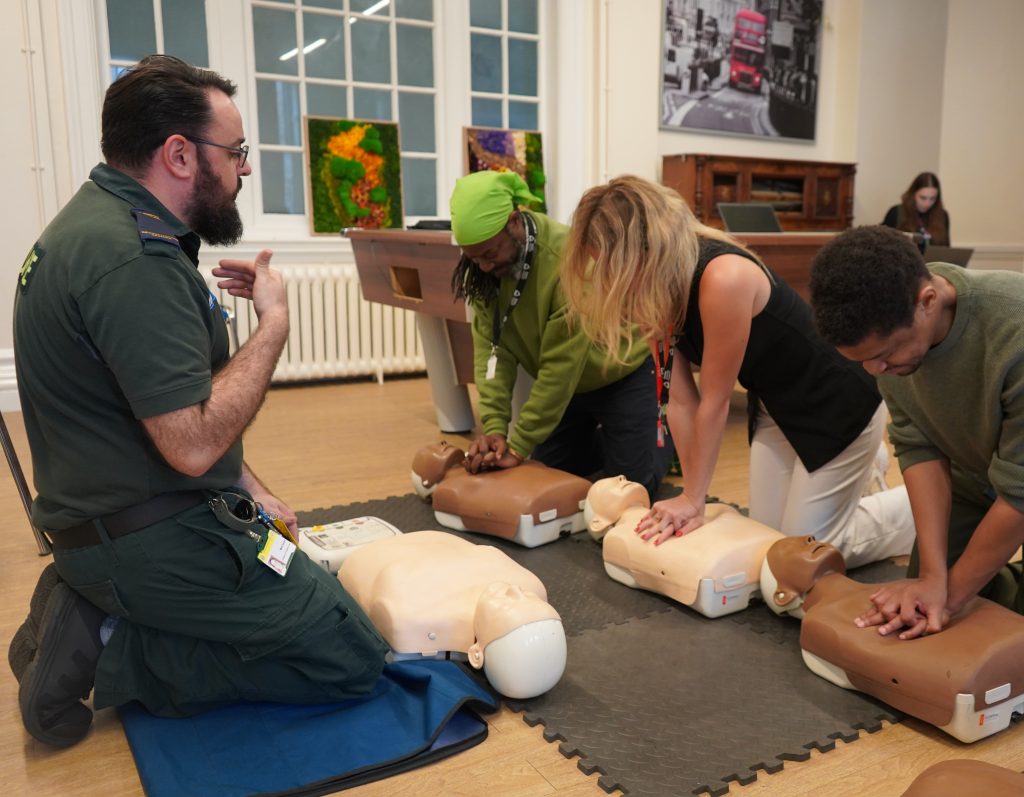
“Early chest compressions and the use of a defibrillator – a device which sends an electric shock to the heart – from bystanders more than doubles a person’s chance of surviving.
“This is easy and simple to do but must be done before an ambulance arrives. These skills take a matter of minutes to learn and anyone can use a defibrillator.
“We want Londoners, regardless of where they live, to have a fighting chance to survive a cardiac arrest and we need our incredible communities to help us save more lives.”
The figures are contained in an annual report, prepared by London Ambulance Service’s Clinical Audit Research Unit, showing the latest data for cardiac arrest in the capital.
Professor Rachael Fothergill, Head of Clinical Audit and Research at London Ambulance Service, added: “Early intervention from Londoners remains absolutely critical. Lives are saved when people nearby act immediately.
“When someone collapses in cardiac arrest, every second counts: call 999 without delay, begin CPR straightaway, and use a defibrillator if one is available.
“We need many more Londoners to make use of the defibrillators that are available across the capital. Too many of these life-saving devices go unused by members of the public, but they could give someone their best chance of survival.”
Since September 2021, the Service’s London Lifesavers campaign has trained nearly 47,000 Londoners as part of its aim to make the capital a city of lifesavers.
The Service has nearly 11,000 defibrillators installed across the capital ready for use in emergencies.
The London Ambulance Charity’s Heart Starters campaign is also installing an additional 200 defibrillators in the 150 neighbourhoods in London where there is no or little access to one of these life-saving devices.
The Charity is working to train a generation of school children in life-saving CPR skills, fund more defibrillators in the neighbourhoods in London where there is no or little access to one of these life-saving devices, and improve cardiac arrest survival rates even further. You can find out more about our charitable campaigns and donate to this great cause at the London Ambulance Charity website.
Londoners can provide early help by signing up to the GoodSAM app which means they will be alerted to cardiac arrests locally, where they can help a person while an ambulance is on the way.
Help us to help people in the capital by becoming a London Lifesaver or by donating to the Heart Starters campaign.