
Ministerial visit showcases ‘green’ vehicle fleet powering the country’s busiest ambulance service
London Ambulance Service welcomed Aviation, Maritime and Decarbonisation Minister Keir Mather MP to its Waterloo Road HQ yesterday (Thursday) to see the variety of electric vehicles used to care for patients in the capital.
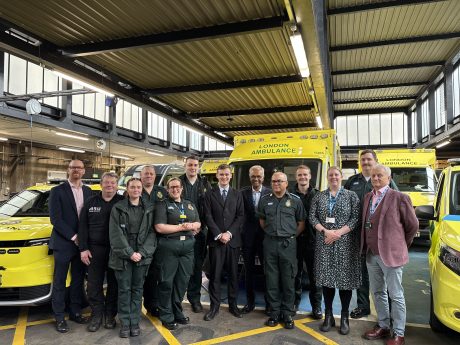
During the visit, Mr Mather heard how London Ambulance Service (LAS) has invested in sustainable vehicles to phase out diesel and other polluting vehicles as they reach the end of their mechanical life. In the HQ workshop he saw electric Ford ambulances, a new Ford Explorer car, a Ford Mustang and a Mercedes eVito, as well as the EV charging infrastructure that powers the new fleet.
The visit came ahead of the Department of Transport (DfT) announcing £4 million for the NHS to roll out hundreds of new EV charging sockets on top of more than 1,000 sockets previously announced to power up electric ambulances and fleets. The funding will help decarbonise 460 million miles of travel each year.
LAS has received £690,525 from DfT. A number of EV chargers at Waterloo were installed with part of this funding, along with a number of other chargers located at Heathrow airport and other LAS hubs in the capital.
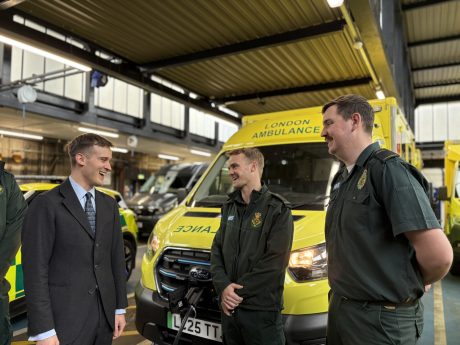
Aviation, Maritime and Decarbonisation Minister, Keir Mather said:
“Backing the switch to electric for our NHS fleet will save our health sector millions and help to clean up 460 million miles worth of journeys across England – that’s good for taxpayers, patients, and our communities.
“With over 116,000 public chargers now on UK roads, our investment is transforming the UK’s public charging network so more drivers can make the switch to electric with confidence.”
Mr Mather met paramedics who shared their experience of using the electric vehicles as they go about their work on the front line.
Paramedic Oli Pond based at Oval Ambulance Station explained there are no compromises between the old diesel ambulances and their modern electric counterparts.
He said:
“They are comfortable, easy to drive and provide a good environment to assess patients.
“They are also quieter than a diesel engine which is better for patients with sensory issues who may struggle with loud noises.
“Unlike diesel which might need filling up during the shift, these can easily cover the whole shift on a charge which means we can keep on the road for longer and helps our response times to patients.”
London Ambulance Service is committed to reducing its environmental impact and saw a reduction of 12% in our carbon emissions over the past three years. We are looking to build on this success with plans to reduce carbon emissions by a further five per cent each year between now and 2029.
To find out more about our plans, visit the LAS website.
Follow us on social media: